Vastu room guide
Puja room Vastu
The puja room is the quietest room in the house and Vastu gives it the most sacred corner, the north-east. Even a single shelf in the right place, kept clean, counts as a puja room.
At a glance
Puja room: quick facts
- Best direction
- North-east
- Workable
- West, North-west, Centre
- Avoid
- South-east, South, South-west
- Colours
- White, cream, light yellow or pale blue. Avoid dark colours.
Why it matters
Puja room in Vastu
The puja room is where the family starts the day, and Vastu wants it in the north-east because of the morning light and the calm it brings. Ishana, the deity of the north-east, is a form of Shiva, and Jupiter, the planet of prayer and wisdom, rules this corner.
In small city flats a dedicated room is often impossible. That is fine: a wall-mounted mandir or a shelf in the north-east of the living room works. What matters most is direction, cleanliness and that the space is used every day.
Direction by direction
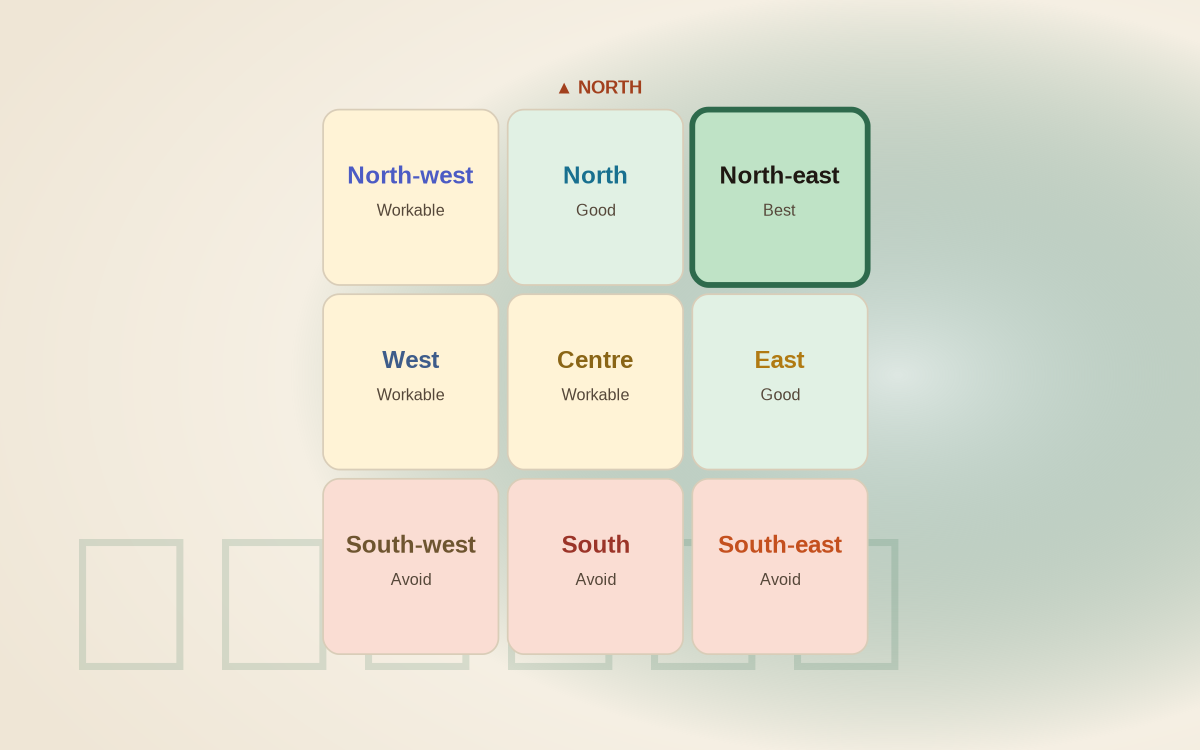
Puja room in every direction, rated
North is at the top of the grid, the way Vastu plans are drawn. Green is where the room works best; red is where it creates a defect.
The short answer
Best: North-east.
Avoid: South-east, South, South-west.
The puja room is the quietest room in the house and Vastu gives it the most sacred corner, the north-east. Even a single shelf in the right place, kept clean, counts as a puja room.
| Direction | Verdict | Why |
|---|---|---|
| North-east | Best | The ideal place. Morning light, calm and the blessings of Ishana and Jupiter. |
| East | Good | Very good. Sit facing east while praying. |
| North | Good | Good. Linked with peace and prosperity. |
| West | Workable | Workable if the person faces west while praying. |
| North-west | Workable | Acceptable if nothing else is possible. |
| Centre | Workable | Traditionally acceptable in a courtyard house, but avoid in flats where it may be cramped. |
| South-east | Avoid | Avoid: the fire corner suits a havan, not a quiet mandir. |
| South | Avoid | Avoid: the person would face south while praying. |
| South-west | Avoid | Avoid: the heavy corner, linked with ancestors. |
Inside the room
Puja room layout rules
- Face east or north while praying; idols then face west or south
- Keep idols a few inches above the floor on a platform, never directly on the ground
- Small idols (under 9 inches) are preferred at home
- Do not place idols facing each other or touching the wall
- Use a wooden or marble mandir; avoid glass shelves
- Keep a diya to the south-east of the idols
- Do not keep broken idols or torn pictures
Colours
White, cream, light yellow or pale blue. Avoid dark colours.
For flats
When you cannot move the puja room
Most city homes come with rooms already fixed. These changes need no breaking of walls.
Simple fixes
- Use a wall-mounted mandir in the north-east of the living room or kitchen
- Do not place the mandir in the bedroom; if unavoidable, draw a curtain at night
- Never put the mandir under a staircase or next to a toilet wall
- Keep the area clean and light a diya daily, even for a minute
Common mistakes
- Puja room under the staircase
- Sharing a wall with a toilet
- Storing old newspapers or junk in the mandir cabinet
- Too many idols of the same deity
- Pictures of ancestors in the mandir (keep them in the south)
FAQ
Questions people ask
Which direction is best for the puja room?
North-east is ideal, with east and north as good alternatives.
Which way should I face while praying?
East or north.
Can the mandir be in the bedroom?
It is better avoided. If necessary, place it in the north-east of the bedroom and cover it with a curtain at night.
Can I keep ancestors' photos in the puja room?
No. Keep them on the south wall of another room.
What is the right height for idols?
Small idols, placed so that their feet are at about the level of your chest when you sit.
Keep exploring