Vastu · Brahmasthan · ब्रह्मस्थान
Brahmasthan: the centre of the house
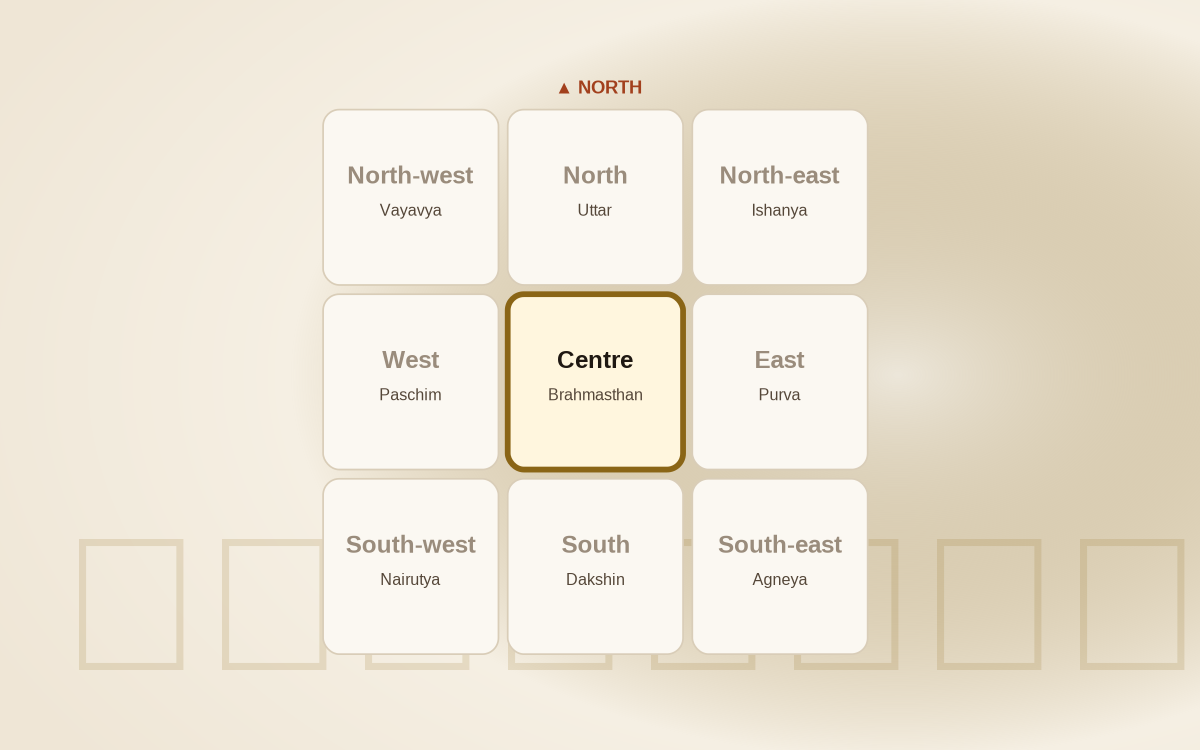
The Brahmasthan is the centre of the house, the space Vastu dedicates to Brahma, the creator. It is meant to be empty: no pillars, no walls, no toilets, no weight. Everything else in the house is arranged around this breathing space.
At a glance
Brahmasthan: quick facts
- Sanskrit name
- Brahmasthan (ब्रह्मस्थान)
- Ruling deity
- Brahma
- Element
- Space (akasha)
- Planet
- —
- Colours
- White, cream, pale yellow
- Best for
- Open space
- Never here
- Pillars, beams or a load-bearing wall
Brahmasthan · ब्रह्मस्थान
What the centre means in Vastu
In the Vastu Purusha Mandala, the 81 (or 64) squares of the grid are divided among deities, and the central block belongs to Brahma. The navel of the Vastu Purusha sits here. That is why the centre of the house is kept open, and why the old Indian courtyard house, with its open centre to the sky, is considered the ideal plan.
Practically, an open centre lets light and air reach every room, and keeps the house from feeling cramped. Modern apartments rarely have a courtyard, but the same principle can be followed by keeping the central part of the flat free of heavy furniture and clutter.
A blocked Brahmasthan is linked with poor health, a sense of being stuck and family members not communicating. A clean, open centre is linked with harmony, good health and a house that "breathes".
Placement
What to keep in the centre, and what not to
Good here
- Open courtyard or atrium
- An open hall or living area
- A skylight
- A simple rangoli, a small tulsi plant or a light rug
- Light, uncluttered furniture
Keep out
- Pillars, beams or a load-bearing wall
- Toilet or bathroom
- Staircase or lift
- Kitchen
- Heavy furniture or storage
- An underground tank or septic tank
Room by room
Every room in the centre, rated
Tap a room for its full guide, with the best and worst directions.
| Room | Verdict | Why |
|---|---|---|
| Puja room | Workable | Traditionally acceptable in a courtyard house, but avoid in flats where it may be cramped. |
| Main door | Avoid | Not applicable for a house; in flats, a door opening straight into the centre should be avoided. |
| Children's room | Avoid | Avoid: keep the centre open. |
| Kitchen | Serious defect | Avoid: fire in the Brahmasthan disturbs the whole house. |
| Master bedroom | Serious defect | Avoid: a bedroom in the Brahmasthan blocks the centre of the house. |
| Toilet and bathroom | Serious defect | A serious defect: the centre of the house. |
| Staircase | Serious defect | A serious defect: blocks the Brahmasthan. |
| Water tank | Serious defect | Avoid both: never place water in the Brahmasthan. |
Diagnosis
Signs of a disturbed centre, and simple fixes
No demolition needed for any of these. Start with the free ones: clearing, cleaning and moving furniture.
Common signs
- Chronic health issues, especially digestion
- Family members who rarely sit together
- A house that feels heavy and suffocating
- A sense that life is stuck
- Financial instability
Fixes for flats and rented homes
- Clear clutter and heavy furniture from the centre
- Keep the central area well lit, with a ceiling light or skylight
- Place a copper Vastu pyramid or a Brahma yantra if there is a pillar
- Draw a rangoli or keep a light rug instead of a heavy table
- Use the central area for family gatherings
Plot shape
Cuts and extensions in the centre
A structure in the centre (a staircase, wall or toilet) is a serious defect. If it cannot be moved, keep it clean and well lit, and place a copper pyramid or plate nearby.
In apartments, the "centre" is the centre of your flat, not the building. Keep that area open as far as possible.
This zone belongs to the space element (Akasha)
FAQ
Questions people ask
What is the Brahmasthan?
The central part of a house or plot in Vastu, dedicated to Brahma. It should be kept open, clean and free of heavy structures.
Can there be a pillar in the centre of the house?
It is best avoided. If unavoidable, keep the area clean and bright, and place a copper pyramid near it.
Can the staircase be in the Brahmasthan?
No. A staircase in the centre is considered a major defect.
What should be kept in the centre of the house?
Ideally nothing heavy: an open courtyard, a living space, a light rug or a rangoli.
How do I find the centre of my flat?
Draw the plan to scale, connect the opposite corners with diagonal lines, and the intersection is the centre. For irregular shapes, first complete the rectangle.
Keep exploring