Pancha bhuta · जल
Water element (Jala) in Vastu
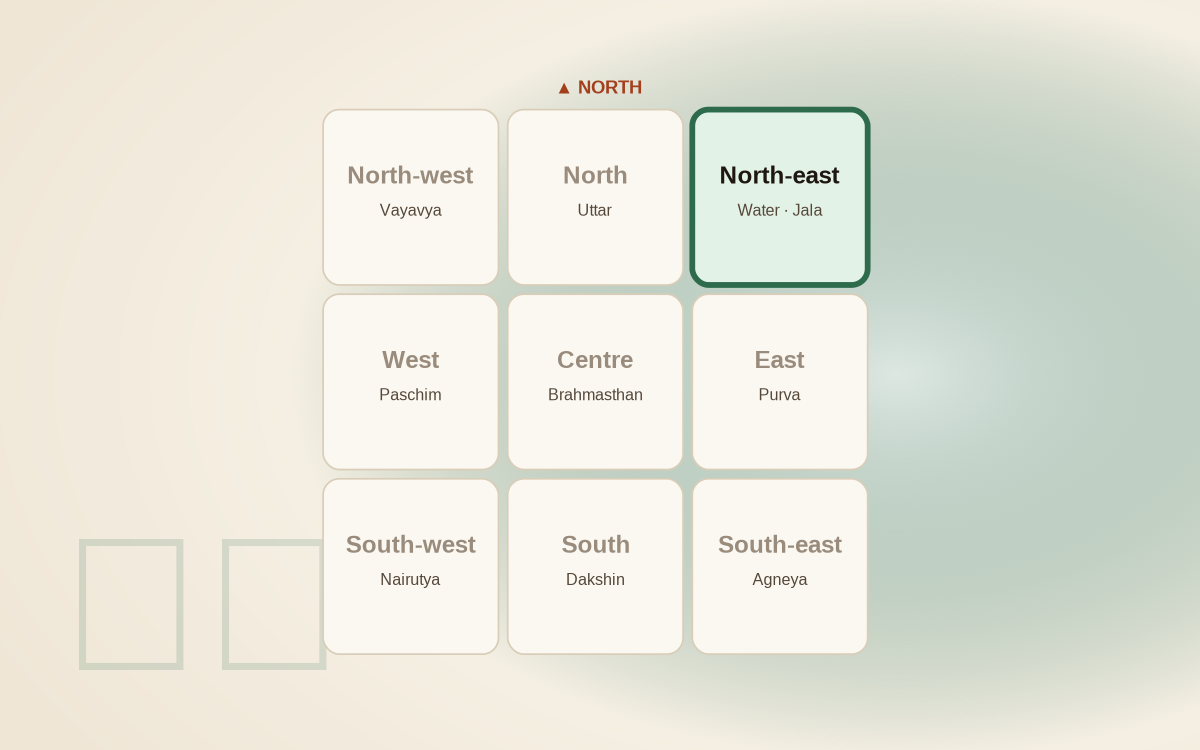
Water is the element of flow and renewal. In Vastu it belongs in the north-east and the north, and getting water in the right place is one of the oldest rules of house-building in India.
At a glance
Water: quick facts
- Sanskrit name
- Jala (जल)
- Zone
- North-east
- Sense
- Taste
- Qualities
- Flow, purity, emotion, renewal
- Shapes
- Wavy lines and irregular, flowing shapes
- Colours
- Blue, black, sea green, white
- Materials
- Glass, mirrors, water features, aquariums
- In the body
- Blood, fluids, kidneys
- Planet
- Jupiter (north-east) and Moon
Jala · जल
The water element in Vastu
Jala, water, carries four of the five qualities: you can see, touch, hear and taste it. In Vastu it stands for life, clarity, emotion and the flow of money. The north-east is its home, and the north shares its energy, which is why the underground water source of a house (the well, borewell or sump) belongs there.
This rule came from experience long before it was philosophy. Groundwater in much of India tends to follow the slope of the land, and plots naturally drained towards a lower north-east. A well dug there stayed clean and full. A well dug in the south-west, the high side, often ran dry.
Water in the wrong place is equally important. Underground water in the south-west or south-east is considered one of the most serious Vastu defects, linked with losses, accidents and illness. Overhead tanks are different: they are "heavy" and belong on the south-west or west of the roof.
Balance
Signs of water in and out of balance
In balance
- Clear thinking and good decisions
- Money that flows in steadily
- Emotional calm and good relationships
- Healthy kidneys and circulation
- Creativity and new ideas
Too much
- Emotional overwhelm and mood swings
- Damp, leaking walls and mould
- Overspending
- Too much talking and not enough doing
Too little
- Dry, stagnant finances
- Difficulty expressing emotions
- Lack of new ideas
- Dehydration, kidney or skin dryness
- A house that feels "dead"
Remedies
How to strengthen or calm the water element
To strengthen it
- Place a small fountain, aquarium or a bowl of fresh water in the north-east or north
- Keep the north-east and north clean and well lit
- Use blue, sea green or white in the north
- Hang a picture of a river, lake or waterfall in the north
- Fix all leaking taps immediately — leaks drain the water element
To calm an excess
- Remove water features from the south, south-east and south-west
- Fix damp walls and leaks
- Add warm colours (fire) in the south-east
- Do not keep too many mirrors in one room
In your home
Water in the plan of a house
For water placement: underground water (borewell, sump, underground tank) in the north-east, north or east; overhead tanks in the south-west, west or south; and drainage flowing out towards the north or east. Bathrooms and kitchens are "water-using" rooms but are not part of the water element; their location is decided by other rules. Leaking taps, blocked drains and dripping tanks are treated as a drain on wealth and should be fixed quickly.
Read the full guide to its zone: North-east (Ishanya)
FAQ
Questions people ask
Where should water be kept according to Vastu?
Underground water in the north-east, north or east. Overhead tanks in the south-west, west or south.
Can I keep an aquarium in the house?
Yes, ideally in the north-east or north of the living room. Keep it clean and the fish healthy.
What colours represent water in Vastu?
Blue, black, sea green and white.
Is a borewell in the south-west bad?
Yes, it is one of the most serious Vastu defects and is linked with financial losses and health problems.
What does a leaking tap mean in Vastu?
It is seen as a drain on money and should be fixed immediately.
Keep exploring