Pancha bhuta · वायु
Air element (Vayu) in Vastu
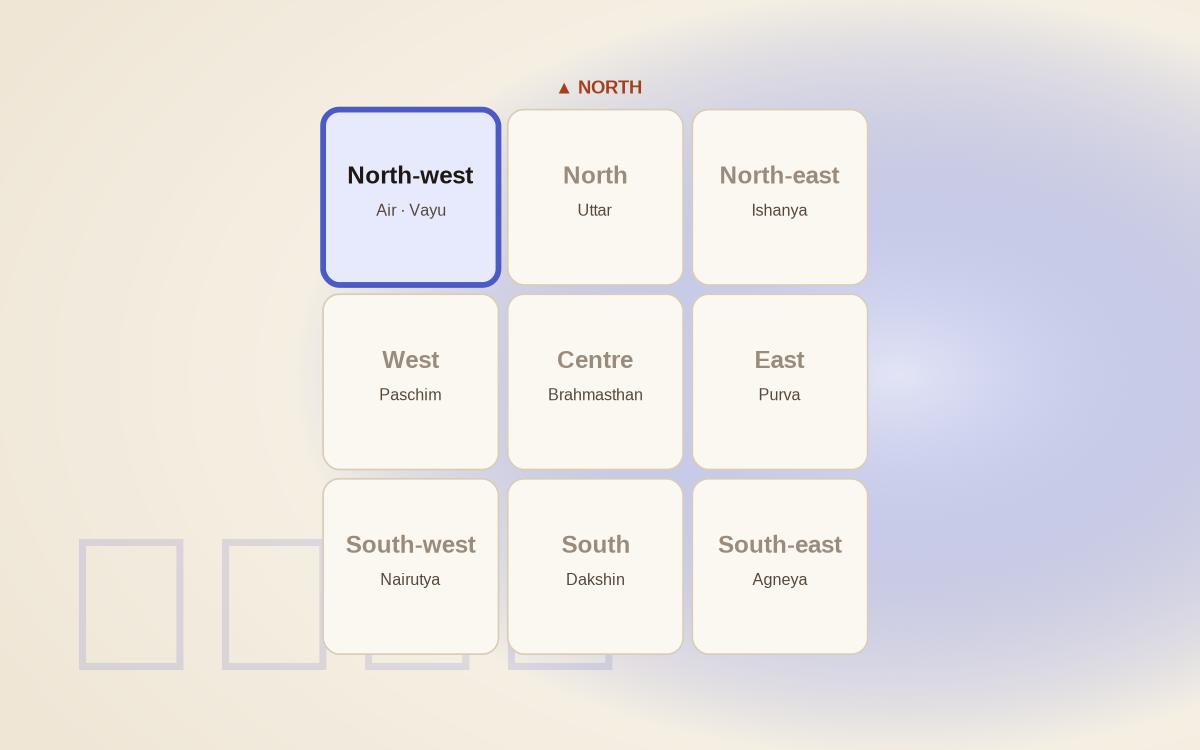
Air is the element of movement. In Vastu it lives in the north-west, and a home with good air keeps its relationships fresh, its business moving and its people breathing easily.
At a glance
Air: quick facts
- Sanskrit name
- Vayu (वायु)
- Zone
- North-west
- Sense
- Touch
- Qualities
- Movement, communication, freshness, change
- Shapes
- Circle and dome
- Colours
- White, grey, silver, cream
- Materials
- Metal, wind chimes, fans, light fabrics, plants
- In the body
- Breath, nervous system, skin
- Planet
- Moon (north-west)
Vayu · वायु
The air element in Vastu
Vayu has two qualities: you can feel it and hear it, but not see it. It governs breath, movement, communication and change. In Vastu, it stands for relationships, support from others and the flow of business, and it lives in the north-west corner.
The practical side of Vayu is ventilation. Vastu's preference for windows on opposite walls, a well-ventilated kitchen, and more openings in the north and east than in the south and west all come down to letting air move freely. A stuffy, airless house is a Vastu problem as much as a health problem.
Air in balance gives easy friendships, good communication and things that move along. Too much air gives restlessness and instability; too little gives isolation, stagnation and stale relationships.
Balance
Signs of air in and out of balance
In balance
- Good communication and friendships
- Support from people when you need it
- Business that keeps moving
- Easy breathing and fresh energy
- Flexibility and adaptability
Too much
- Restlessness and anxiety
- Inability to settle in one place
- Frequent travel and change
- Scattered thinking
Too little
- Isolation and lack of support
- Stagnant business or stock that does not sell
- Breathing problems and fatigue
- Stale relationships
- Stuffy, smelly rooms
Remedies
How to strengthen or calm the air element
To strengthen it
- Hang a metal wind chime in the north-west
- Keep north-west windows open and use an exhaust fan
- Use white, grey or silver in the north-west
- Place round or oval objects in the north-west
- Keep plants like tulsi, areca palm and money plant for fresh air
To calm an excess
- Move restless activities and frequent-use items to other zones
- Add earth elements (heavy furniture, clay) in the south-west
- Avoid too many fans and open windows in the bedroom
- Settle the household into fixed routines
In your home
Air in the plan of a house
Good air flow means windows on opposite walls (cross-ventilation), exhaust fans in the kitchen and bathrooms, and nothing blocking the north and east windows. The north-west is the natural home for guests, vehicles and goods for sale because air moves on. A closed, cluttered north-west is linked with problems in friendships and business.
Read the full guide to its zone: North-west (Vayavya)
FAQ
Questions people ask
Which direction is the air element in Vastu?
The north-west, ruled by Vayu, the god of wind.
What colours represent air?
White, grey, silver and cream.
Is a wind chime good in Vastu?
Yes, a metal wind chime in the north-west, west or north helps the air element. Use six or eight hollow rods.
How does ventilation affect Vastu?
Good cross-ventilation keeps the air element balanced, supporting health, relationships and business flow.
Which shape represents air?
The circle and the dome.
Keep exploring